


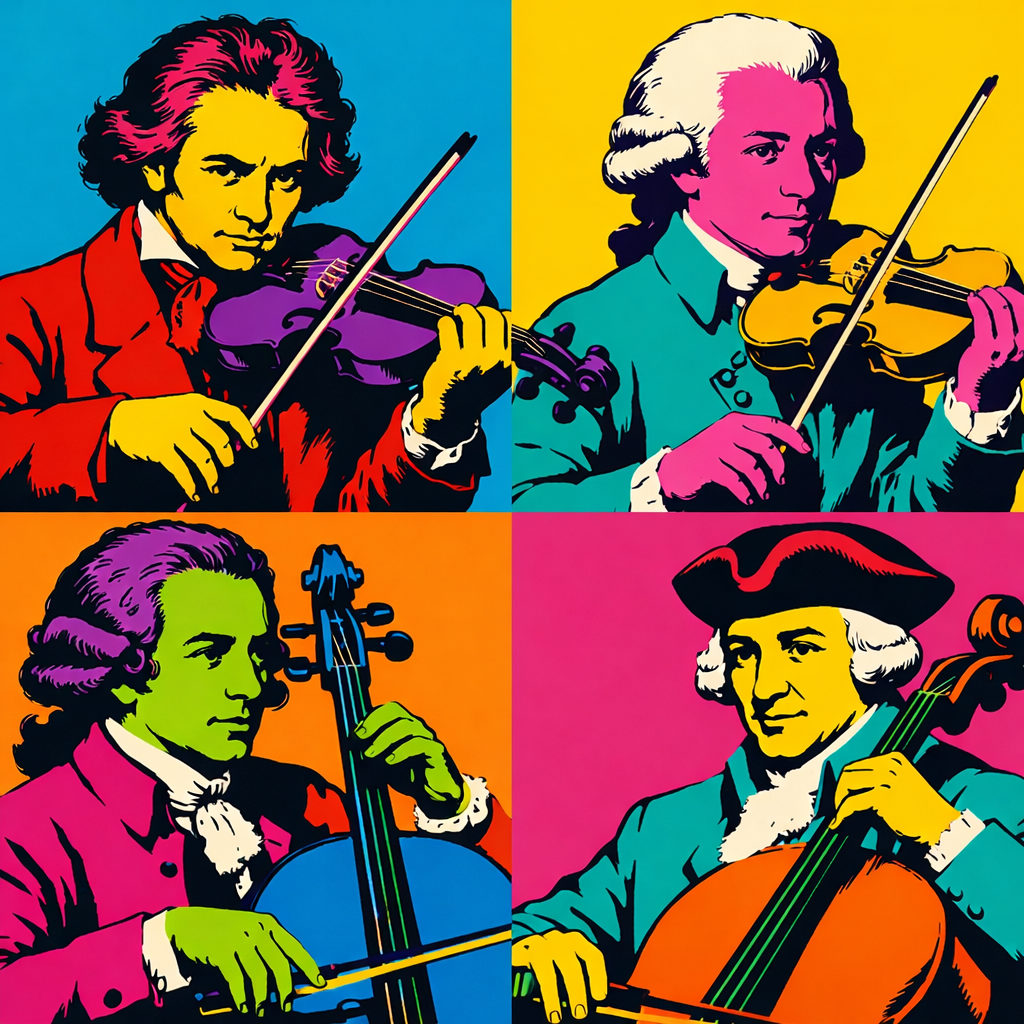
The string quartet was never just notation on paper. Many of the composers who shaped the repertoire actually played string instruments themselves.
So here’s a lighter question: If these composers walked into rehearsal today… where would they sit and how would it go?
Who Takes First Violin?
🎻 Ludwig van Beethoven - 16 string quartets
The late quartets (Opp. 127–135) are especially influential.
Trained on violin before becoming known primarily as a pianist. He participated in chamber music early in his career.
He once wrote:
“Oh you men who think or say that I am stubborn… how greatly do you wrong me.”
Rehearsal prediction: Intense eye contact. Debate over tempo. Possibly rewriting the ending.
You can decide whether that reassures you.
🎻 Béla Bartók - 6 string quartets
All six are considered pillars of 20th-century quartet literature.
Received early violin training and immersed himself in folk traditions.
His philosophy:
“Competitions are for horses, not artists.”
Rehearsal prediction: The rhythm section is now under investigation.
Who Chooses Viola?
🎻 Antonín Dvořák - 14 string quartets
Including the well-known “American” Quartet (Op. 96).
A trained violist who played in orchestras. His quartets often give the viola real personality rather than background support.
He wrote:
“To have a good idea is nothing special. What is special is to work it out well.”
Rehearsal prediction: He would absolutely ask for one more run-through.
🎻 Wolfgang Amadeus Mozart - 23 string quartets
Including the six “Haydn” quartets and the later “Prussian” quartets.
Mozart frequently chose to play viola in chamber settings. It placed him in the middle of the texture, able to hear everything.
That perspective may explain the richness of his inner voices. He once wrote of his quartets:
“These passages are written in such a way that the less learned cannot fail to be pleased.”
Rehearsal prediction: Fixes the balance in one sentence. Then casually plays it perfectly the first time.
Who Anchors the Structure?
🎻 Joseph Haydn - 68 string quartets
(Often called the “Father of the String Quartet” because he standardized and expanded the form.)
Primarily a violinist, long-serving Kapellmeister, master of balance.
He once reflected: “I was cut off from the world… and so I was forced to become original.”
Rehearsal prediction: Smiles politely. Fixes the balance. Adds a musical joke in the development section when no one is looking.
There is, however, one logistical problem.
Most of these composers were violinists. Several preferred viola. But very few of them were cellists.
🎻Enter Luigi Boccherini - Around 90 string quartets
(And over 100 string quintets — often with two cellos.)
A professional cellist and prolific chamber composer, he might look around the room, notice the imbalance, and quietly suggest:
“What if we added another cello?”
Which, historically, he often did.
Four chairs. Four stands.
One open guest seat.
If Boccherini’s coming, you may need a fifth.
So …which composer are you inviting?