


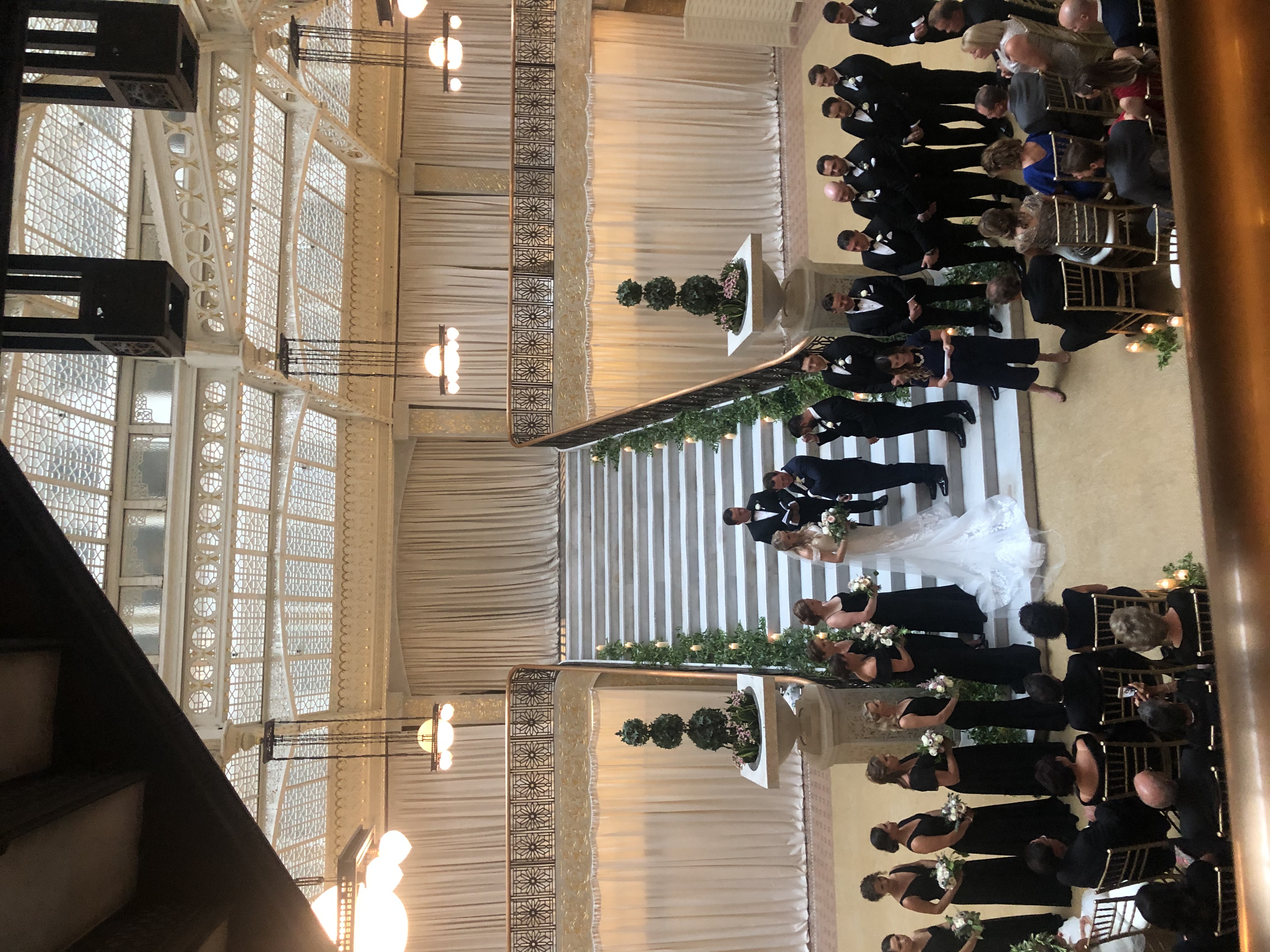
The Rookery
Originally completed in 1888 by Burnham and Root, The Rookery is one of Chicago’s oldest standing high-rises. In 1905, Frank Lloyd Wright was commissioned to redesign the building’s central lobby, creating the now-iconic light court with its marble finishes, geometric detailing, and open, skylit atrium.
Today, the space is frequently used for weddings and private events, making it one of the few Wright-influenced interiors in Chicago that remains actively used for celebrations.
Built between 1905 and 1908, Unity Temple is considered one of Wright’s most important early works and a defining moment in modern architecture. Constructed entirely of reinforced concrete, the building introduced a new architectural language focused on structure, light, and spatial unity.
Designated a UNESCO World Heritage Site, Unity Temple continues to function as a place of gathering and is occasionally used for ceremonies and special events.
Completed in 1915, the Emil Bach House represents Wright’s later Prairie style, with a strong emphasis on horizontal lines and integrated interior spaces. Originally built as a private residence, the home remained in private ownership for much of the 20th century before being restored and reopened.
Today, the house is available for tours, private stays, and select events, offering one of the rare opportunities to experience Wright’s residential architecture in an intimate setting.
Completed in 1910, the Robie House is widely regarded as the most complete expression of Wright’s Prairie style. Its horizontal rooflines, open floor plan, and integration of interior and exterior spaces influenced residential architecture across the United States.
Now operated as a museum, the house hosts tours and educational programs. While not a traditional wedding venue, it remains one of the most significant architectural landmarks in Chicago.
A Note on Weddings in Wright Spaces
While Illinois contains dozens of Frank Lloyd Wright buildings, most were designed as private residences or are preserved as historic sites.
As a result, only a small number—such as The Rookery and the Emil Bach House—are regularly used for weddings or private events. Others, like Unity Temple, may host ceremonies in limited capacities, while many remain dedicated to preservation and public tours.
In these spaces, the architecture sets the tone. Everything that follows, including the music, simply meets it.