


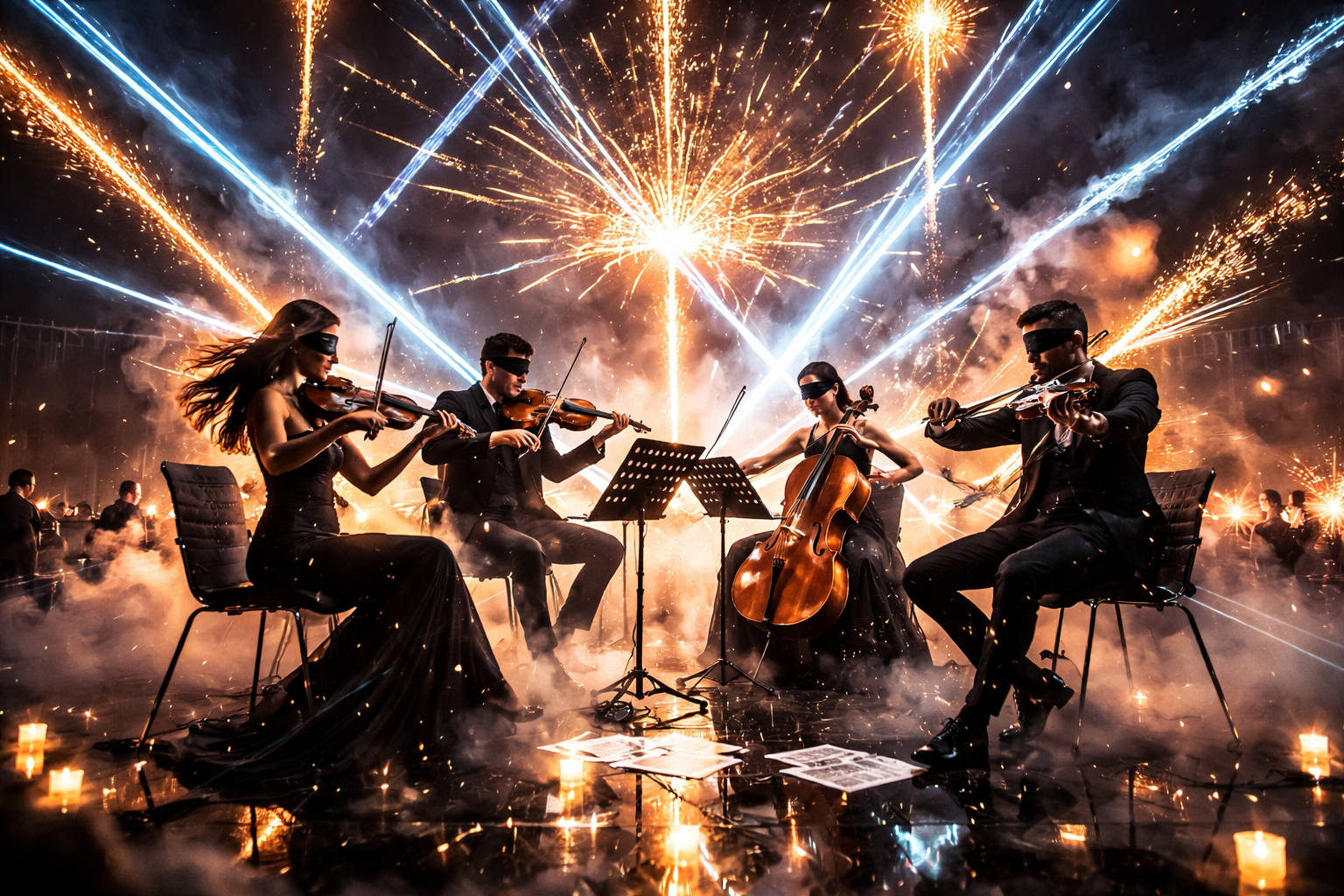
Live string music has always carried its own presence. Recently, though, there has been a shift. Quartets surrounded by candlelight, musicians under colored or laser lighting, and even performances where players are suspended above the space have become more common. In some cases, the setting becomes as much a focus as the music itself, which raises a quiet question. Is the music still the focus, or has it become part of something else?
There is a place for visual design, but it inevitably changes the role of the music. When live strings become part of a larger production, attention shifts outward. The experience becomes something to observe rather than something that settles into the room.
There is a place for visual design, but it inevitably changes the role of the music. When live strings become part of a larger production, attention shifts outward. The experience becomes something to observe rather than something that settles into the room.
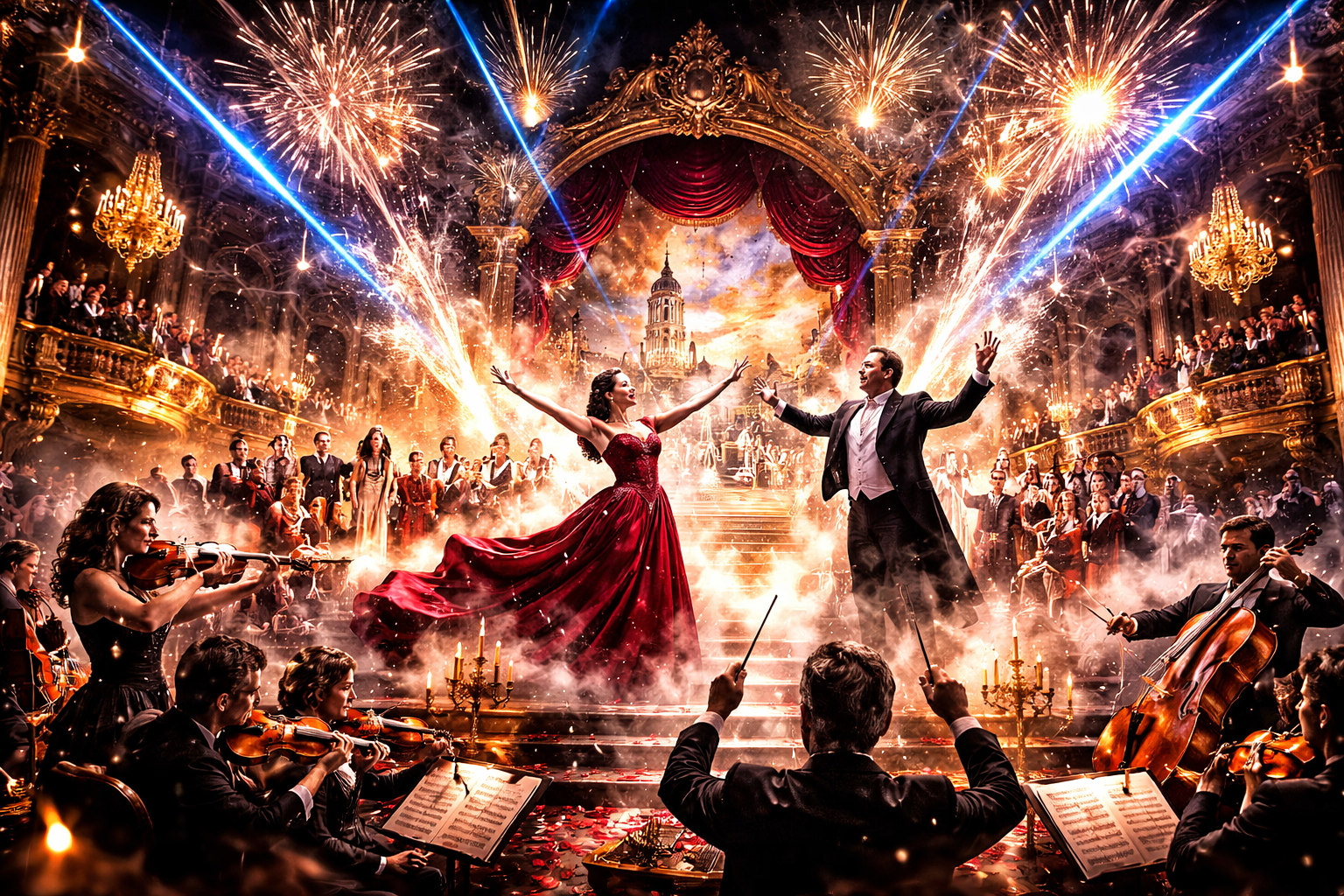
Perhaps this is not entirely new. At different points in history, music has moved in similar directions, becoming larger in scale and more theatrical in presentation. Opera, in its time, was as much about spectacle as it was about sound. In that sense, what we are seeing now may simply be another version of that impulse. But even then, the music was never secondary.
And to be clear, there is something compelling about a well-executed production. A strong visual setting, when done thoughtfully, can elevate a performance in its own way.
When more elements are added around the performance, the focus often shifts. The music is still there, but it is not always what people are listening to most closely. Attention moves to the setting, the lighting, or the overall effect, and the playing itself can become secondary. Part of this shift is shaped by how performances are seen now. Social media tends to favor what reads quickly and visually, and certain formats translate more easily on a screen than others. With the added influence of algorithm-driven content and AI-curated trends, these formats can be amplified and repeated in ways that feel increasingly detached from the music itself.
That is where the quality of the playing becomes worth considering. The sound of the ensemble, the balance, and the way musicians listen and respond to one another are what actually shape the experience. These details may not always be immediately visible, but they are what give the music its depth and presence. When the focus remains on the playing, the experience feels different. The sound carries more clearly, and the atmosphere forms in a way that does not rely on anything extra around it.
At a certain point, it also raises a quieter question. What exactly are we hearing? Is it a real ensemble, responding in real time, or something constructed and reinforced through software, layering, or pre-produced sound? That distinction may not always be obvious, but it changes the experience more than anything else.
After years of performing, the most memorable experiences are rarely the most elaborate. They are the ones where everything feels aligned, where the music, the space, and the moment move together without excess. Live string music does not need to be transformed into something else to feel impactful. In many cases, it is the absence of added elements that allows it to resonate more fully.
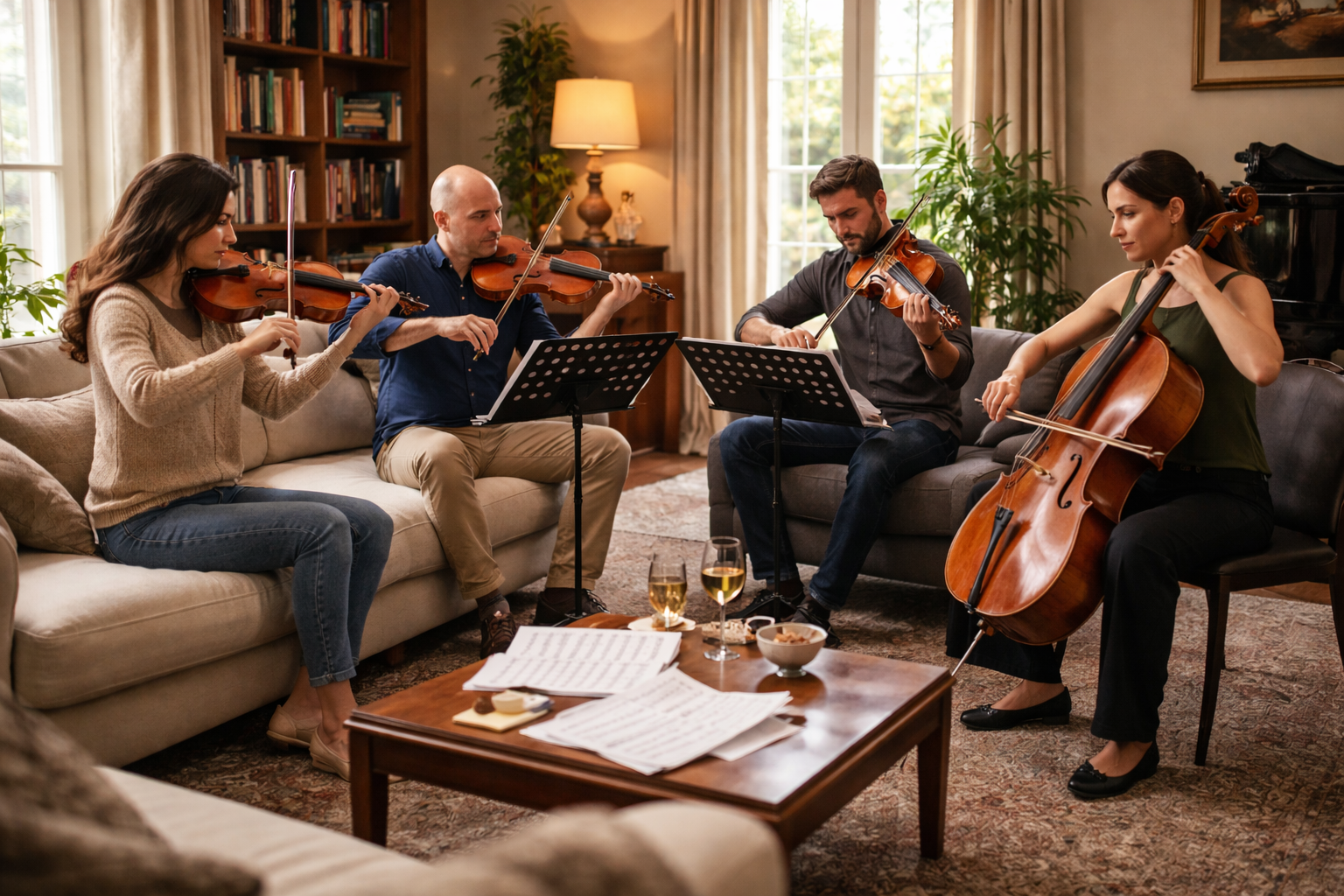
In the end, music does not need to be anything more than what it is. It is experienced in real time, as the moment unfolds, without needing to be shaped into something else. That is enough. And in many ways, it can be a more personal experience than anything else. The music does not need to serve everyone in the room. It can simply be something you connect to on your own terms. I tend to be a little selfish with the music, and stay focused on the experience of it itself, rather than how it might be received.
If you are drawn to an approach that values sound, space, and simplicity, you can explore more of our work here.
🎧 Visit our Sound Library
→ Browse our blog for inspiration