-
0:00/3:45
Famous String Players Through Time
The Artists Who Shaped the Sound of the Violin, Viola, Cello and Double Bass
Music evolves — but great artistry endures. From the salons of the 18th century to today’s concert stages and film scores, violinists, violists, and cellists have carried forward the expressive power of string music. Their performances continue to influence how we play, teach, and hear these instruments.
⚡When Sound Became a Form of Survival
Throughout history, many of the world’s greatest string players were forced to leave their homelands — escaping persecution, war, or censorship. Yet in exile, their artistry deepened. Their music carried memory, loss, and hope — proving that even in the darkest times, art can endure and transcend.
The Violinists
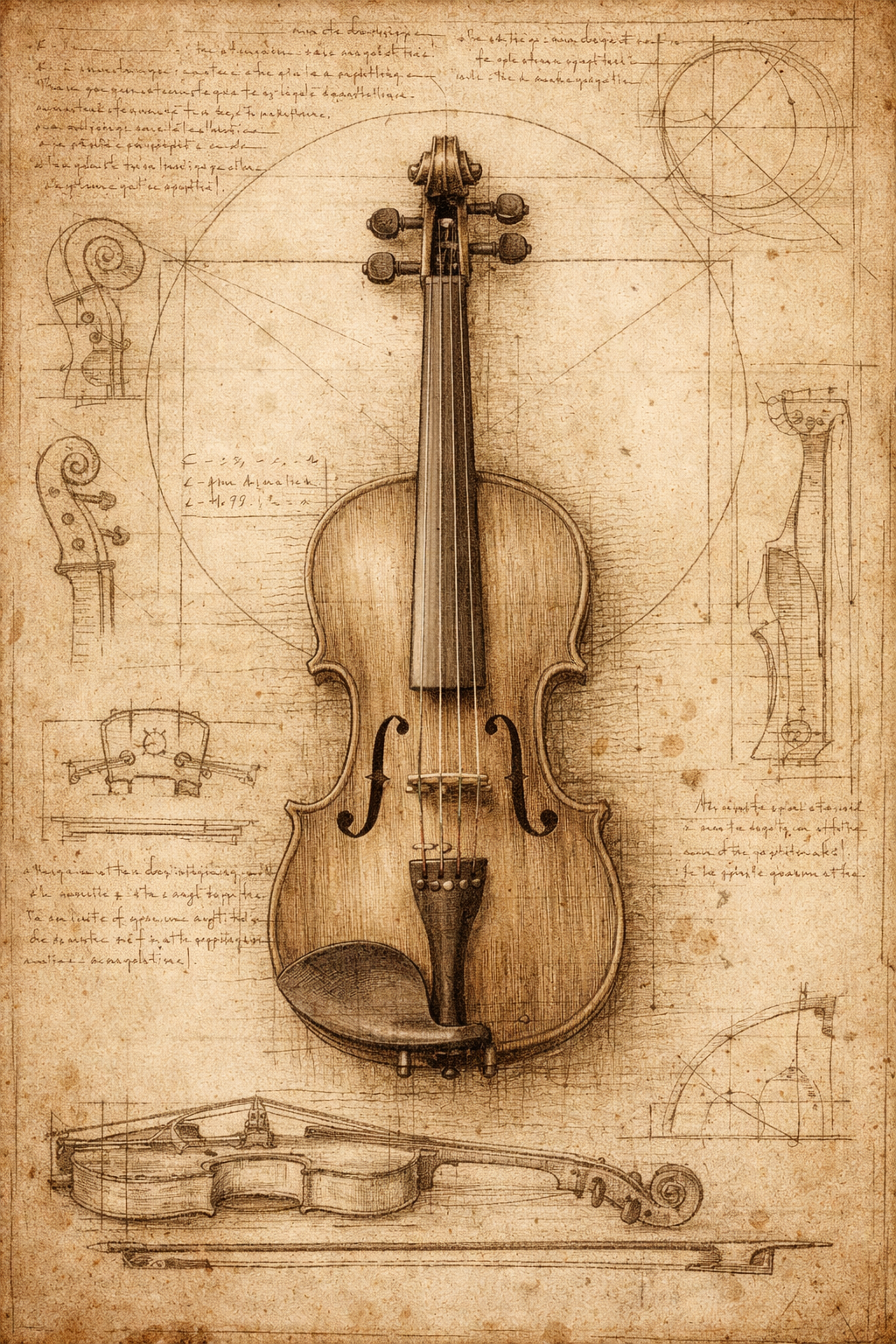
The violin has always held the spotlight — a voice of brilliance and emotion.
Antonio Vivaldi (1678–1741) – Baroque composer and virtuoso whose Four Seasons remains one of the most beloved works for violin.
Niccolò Paganini (1782–1840) – Known for his dazzling technique and near-mythical performances that redefined what the violin could do. ⚡ His near-supernatural virtuosity made audiences believe he had struck a deal with the devil. Paganini’s performances were so electrifying that they blurred the line between genius and myth.
Fritz Kreisler (1875–1962) – One of the most beloved violinists of the early 20th century, Kreisler was admired for his warm tone and expressive style. His short character pieces such as Liebesleid and Liebesfreud remain staples of the violin repertoire and capture a uniquely nostalgic Viennese charm.
Bronisław Huberman (1882–1947) – A Polish violinist who fled Nazi persecution and went on to found the Palestine Symphony Orchestra (which became the Israel Philharmonic). ⚡He saved hundreds of Jewish musicians and their families from the Holocaust through his efforts.
Mischa Elman (1891–1967) – A Russian-American violinist known for his warm tone and expressive playing. ⚡His recordings reached a wide audience in the early 20th century, including a young Shinichi Suzuki, who was inspired to begin learning the violin after hearing him.
Joseph Szigeti (1892–1973) – ⚡Hungarian violinist who fled Europe during World War II, resettling in the United States. His exile brought a profound depth and melancholy to his playing that listeners still associate with him.
Shinichi Suzuki (1898–1998) – A Japanese violinist and educator who began studying the instrument at seventeen after hearing a recording of Mischa Elman. He later moved to Germany in his early twenties to continue his studies and went on to develop one of the most widely used violin teaching methods in the world.
⚡ Suzuki's teaching method has shaped generations of violinists, beginning in an unexpected way.
→ Before the Method: Shinichi Suzuki
Jascha Heifetz (1901–1987) – His precision and tone became the 20th-century standard of violin excellence.
Yehudi Menuhin (1916–1999) – Though not a refugee himself, Menuhin publicly defended artists who fled persecution, including the banned German conductor Wilhelm Furtwängler. ⚡His advocacy for displaced musicians was both controversial and courageous in post-war Europe.
Itzhak Perlman (b. 1945) – Celebrated for his warmth, expressiveness, and lifelong contribution to violin artistry.
Nigel Kennedy (b. 1956) – ⚡ Known for his punk-inspired performances and outspoken personality, Kennedy rebelled against orchestral decorum, famously wearing sneakers on stage and calling for reform in classical music.
Anne-Sophie Mutter (b. 1963) – A figure of both admiration and debate, Mutter has challenged traditional interpretations and spoken candidly about the classical world’s gender imbalance, sparking conversations that still echo today.
Kyung-Wha Chung (b. 1948) - One of South Korea’s most influential classical musicians, Chung emerged onto the international stage during a period when Asian soloists were still rare in major Western concert circles. Her powerful performances and distinctive musical voice helped redefine who could stand at the center of the classical world.
Vanessa-Mae (b. 1978) – By merging classical violin with techno and pop, she broke into mainstream culture — ⚡and classical purists weren’t pleased. Yet her success brought new audiences to string music.
Hilary Hahn (b. 1979) – A modern icon whose clarity, intelligence, and emotional depth continue the instrument’s legacy.
Ray Chen (b. 1989) – An international concert violinist known for combining high-level performance with a strong online presence. Through social media and digital platforms, he has introduced classical violin to new audiences, expanding how the instrument is experienced today.
The Violists

The viola’s voice — warm, introspective, and noble — found its champions later in history.
Lionel Tertis (1876–1975) – The pioneer who elevated the viola from orchestral background to solo prominence.
Paul Hindemith (1895–1963) – Primarily known as a composer and violist, Hindemith’s music was condemned by the Nazi regime as “degenerate.” ⚡He fled Germany for Switzerland, and later the U.S., continuing to champion artistic freedom through his work and teaching.
William Primrose (1904–1982) – His bold, soloistic approach to the viola challenged centuries of its supporting role. ⚡Critics called his tone “too forward” — until it became the new standard.
Nobuko Imai (b. 1943) – One of the first Asian violists to achieve international acclaim, ⚡Imai faced cultural bias early in her career. Her persistence helped redefine who could lead on the world stage.
Tabea Zimmermann (b. 1966) – Revered for her artistry and advocacy of new works for the instrument.
Kim Kashkashian (b. 1952) – A leading interpreter of modern and 20th-century repertoire, merging elegance with emotional intelligence.
The Cellists

The cello’s expressive range — from deep resonance to lyrical warmth — has made it the emotional center of the string family.
Luigi Boccherini (1743–1805) – Composer and cellist whose graceful works defined the instrument’s early classical style.
Pablo Casals (1876–1973) – Revolutionized cello playing with his soulful interpretations and revival of Bach’s Cello Suites.
Emanuel Feuermann (1902–1942) – ⚡ Fled the Nazi regime after being dismissed from his professorship in Berlin because of his Jewish heritage. Despite exile, his recordings remain among the most admired in cello history.
Mstislav Rostropovich (1927–2007) – A fearless defender of artistic freedom, ⚡ Rostropovich was exiled from the Soviet Union for sheltering dissident artists. His courage made him a hero — and a political target.
Jacqueline du Pré (1945–1987) – Her passionate performances of Elgar’s Cello Concerto are legendary. Her emotional intensity redefined the cello’s voice. ⚡Yet her fame also sparked ethical questions about media fascination with her illness — when does admiration become intrusion?
Mischa Maisky (b. 1948) – Known for his rich tone and romantic phrasing that bridges generations.
Yo-Yo Ma (b. 1955) – A global ambassador of music whose range spans classical, folk, jazz, and film.
Sol Gabetta (b. 1981) – An Argentine cellist known for her clarity of tone and thoughtful interpretations of both classical and lesser-known repertoire. Her international career has helped bring renewed attention to cello works beyond the standard canon.
The Double Bass

The double bass anchors the string family with power and resonance — yet many virtuosos have proven its lyrical and solo potential.
Giovanni Bottesini (1821–1889) – Known as “the Paganini of the Double Bass,” Bottesini expanded the instrument’s technical and expressive range through his dazzling Romantic works.
Serge Koussevitzky (1874–1951) – Renowned both as a bassist and conductor; his Double Bass Concerto remains a cornerstone of the repertoire. ⚡His Double Bass Concerto was criticized at first for being “too romantic” and technically excessive — some even doubted it could be played by anyone else. His defiance of those limits made him both admired and debated.
Charles Mingus (1922–1979) – While primarily a jazz bassist and composer, Mingus blurred the line between jazz improvisation and classical structure. ⚡His outspoken personality, political views, and explosive temper made him one of the most controversial musicians in any genre — and a symbol of artistic defiance.
Franco Petracchi (b. 1937) – Italian virtuoso known for his elegant bow control and expressive solo style. ⚡Caused waves in the 1970s by publishing Simplified Higher Technique for Double Bass, which challenged generations odouble bass in Chicagof traditional fingering systems. Traditionalists called it “radical,” but it later redefined professional bass pedagogy.
Gary Karr (b. 1941) – Credited with bringing the double bass to international concert stages; known for his warmth of tone and advocacy for the instrument.
Edgar Meyer (b. 1960) – A modern American bassist who bridges classical, jazz, and bluegrass, redefining what the bass can do. ⚡His cross-genre collaborations with bluegrass, jazz, and pop musicians like Béla Fleck and Chris Thile have been celebrated and critiqued. Classical traditionalists saw it as a departure from purity; others praised it as visionary.
Inspired by the past, Shaped for the present
History's original rock stars →
Unexpected stories from music's earliest celebrities.
→ Why Royal Courts Feared Their Own Entertainers
Before modern celebrity culture, musicians, jesters, and court performers already held unusual influence — entertaining royalty while navigating rivalry, spectacle, and political tension inside royal courts.

Explore More
Explore Our Sound Library 🎧
Listen to live performance samples featuring classical works, film music, modern arrangements, and unexpected favorites for strings.
